

Generative AI is reshaping how employees learn, decide, and produce. The data is striking: a Harvard/BCG study on 758 consultants revealed that those using AI completed more tasks, 25% faster, with 40% higher quality. Yet, Deloitte notes a crucial nuance: true ROI comes from redesigning work around a "Humans × Machines" synergy, not just deploying the tool. At this adoption pace, an uncomfortable question surfaces: what happens to the brains of employees who offload their thinking to AI? A viral 2025 MIT Media Lab study, Your Brain on ChatGPT, delivered a wake-up call by coining the term "cognitive debt." This hidden cost changes everything, reshaping the critical conversation L&D must now have with senior leadership.

What MIT actually measured inside the brains of AI users
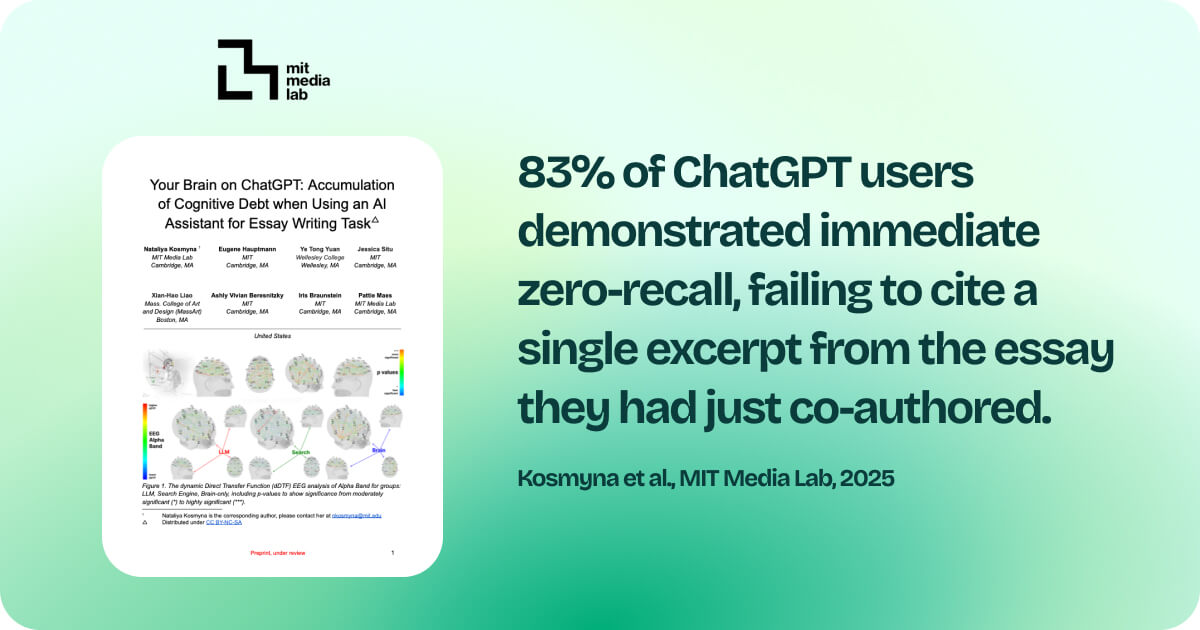
The study by Nataliya Kosmyna and her team at the MIT Media Lab is not an opinion piece. It is a controlled, multimodal experiment that followed 54 participants over four months using EEG (electroencephalography), text analysis through NLP (natural language processing), and behavioral interviews.
The protocol is simple. Three groups write essays across three sessions, under three conditions: ChatGPT, a search engine, or brain only. Then, in a fourth session, the groups are swapped. This makes it possible to observe not only the immediate effects, but above all what remains once the AI is taken away.
The results are clear.
83% of ChatGPT users were unable to quote a single line from the essay they had just written themselves. (Kosmyna et al., MIT Media Lab, 2025)
The EEG recordings show neural connectivity declining as the tool takes over the effort. The "brain only" group shows the densest and most distributed networks. The ChatGPT group, the weakest. And when ChatGPT users are deprived of the tool for the fourth session, their connectivity does not immediately return to the levels of the other groups.
The linguistic analysis confirms the phenomenon on another level. The ChatGPT essays show such uniformity of vocabulary and structure that the human graders, who did not know which essays came from which group, suspected collusion between students. The most unexpected effect is not the drop in quality, it is the loss of ownership. ChatGPT users report that they no longer recognize themselves in their own work.
This is exactly what Kosmyna calls cognitive debt: a deferred, silent cost that does not show up on the quarter's productivity metrics, but that accumulates as we delegate to AI the acts of thinking that used to structure our cognition.
Why this debt concerns L&D directly
The temptation, when reading these results, is to file them under cyber risk or IT governance. That would be a mistake. Recent work from Stanford (notably the AI Index report) and educational research converge on one finding: the impact of AI is, above all, cognitive and human. Three major mechanisms place the topic at the very heart of the L&D mission:
The atrophy of foundational skills. Writing, analyzing, coding, structuring an argument: these skills are maintained only through regular practice. When AI does the work instead, they fade away. The juniors who never write a sales email from scratch will not learn the subtle art of doing so.
The erosion of critical thinking. When an AI always provides an answer, the reflex to question fades. What used to be an internal debate becomes a copy and paste.
The loss of professional identity. The feeling of contributing to something unique, which motivates and retains talent, erodes when the output comes from a model. This is an HR topic before it is an AI topic.
The stakes are not trivial. What is at play is the learning value proposition of companies themselves. In a world where knowledge becomes a commodity available in two clicks, what sets an organization apart is its ability to grow its people differently.
"Are we using AI to do things we could not do before, or to augment human capabilities, cognitive or emotional? That is not the same answer."
Thierry Bonetto
Founder, LearningFutures, (Blify × Deloitte × LearningFutures webinar, March 2026)
Thierry Bonetto's question is not philosophical. It is a question of product design. An AI can be built to bypass thinking, or to engage it. The effect on cognitive debt is diametrically opposite.
The counterpoint that changes everything: the Cognitive Offloading Paradox
The story does not stop with Kosmyna. In March 2026, the International Journal of Educational Technology in Higher Education published a study that complicates, and enriches, the picture.
Wang and Zhang followed 912 students across China, Europe, and the United States. Their question: what happens when a learner treats AI not as a passive tool, but as an intellectual partner? The numbers are remarkable.
β = 0.437 Effect of cognitive vigilance on transformative learning
Cognitive vigilance: the learner's active stance, critically evaluating, verifying, and questioning the outputs generated by AI rather than accepting them blindly.
β = 0.333 Effect of strategic delegation to AI on transformative learning
Strategic delegation: the deliberate choice to hand the AI certain automatable or exploratory tasks, not to offload the work, but to free up mental space and focus on higher level thinking.
* The beta coefficient (β) measures the strength of the effect: the higher it is, the more directly the student's stance (vigilance or delegation) contributes to their intellectual transformation.
The finding is counterintuitive: critical vigilance and delegation do not exclude each other. They can coexist. And when they coexist, they both produce transformative learning, that is, the learner's ability to question their own assumptions, change how they see a topic, and reconfigure their thinking at depth.
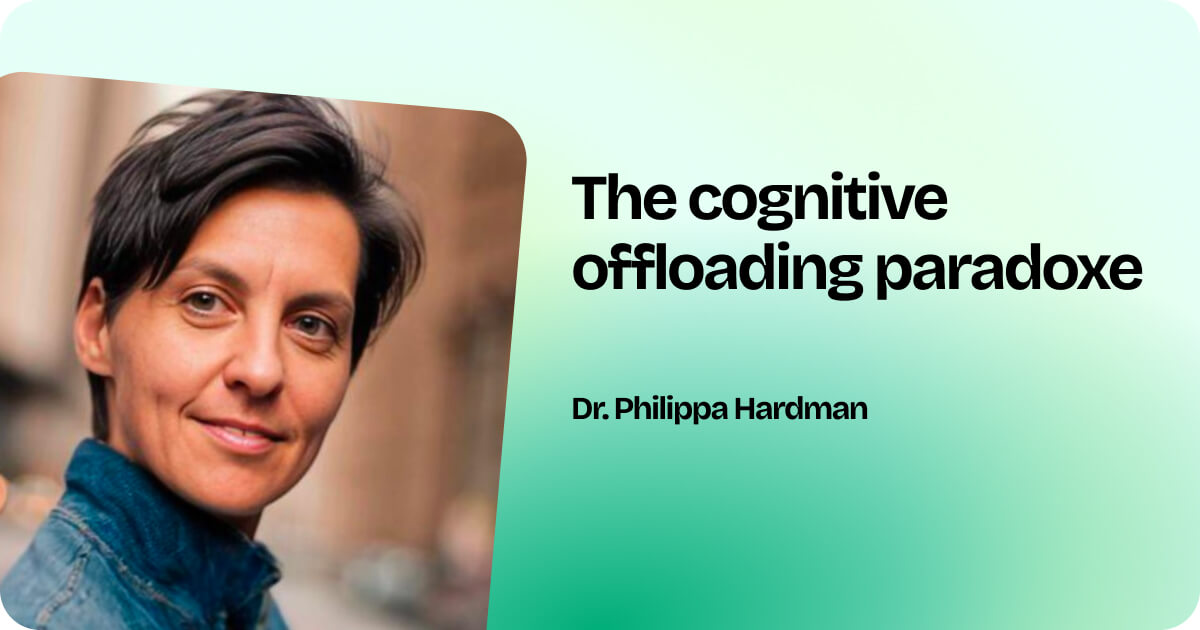
This is what researcher Dr. Philippa Hardman popularized as the "Cognitive Offloading Paradox": the very mechanism that creates debt under some conditions can create cognitive reinforcement under others. The difference is not about the tool. It is about the stance of the learner toward the tool, and the way the learning experience is designed around it.
A third major study confirms the shift. Lira et al. (2025), in a paper with a telling title, "Coach not Crutch: Evidence that AI can improve writing skill despite reducing effort", ran large scale controlled experiments on thousands of adults. The result: under certain conditions, AI assistance did not just boost immediate performance. It improved skills over the long term, even after the AI was taken away.
The conditions, precisely. Lira et al. name them: controlled practice, guided instruction, exposure to high quality examples. In other words, learning design. The very variable that separates an LMS stuffed with SCORM modules from a real learning experience.






Webinar
Building on the visionary work of Peter Senge, Florent Grisaud Verrier (Head of L&D, Deloitte), Thierry Bonetto (Founder, LearningFutures), and Clément Lhommeau (Co-founder, Blify) will detail how to balance technological amplification with human vigilance. They will share concrete tools to embed learning directly into the flow of work. This is an essential roadmap to shift away from administrative management and finally orchestrate dynamic skills ecosystems.

What L&D should do with this, concretely
These three studies converge on a conclusion that goes well beyond the debate over embracing or rejecting AI. Cognitive debt is not an inevitable byproduct of AI. It is the consequence of a certain type of AI usage, the kind that asks for an answer and pastes it. Conversely, when AI is designed to make the brain work, the effects reverse.
The distinction is sharp.
On one side, an AI that gives the answer produces cognitive debt.
On the other, an AI that asks questions, builds scenarios, and forces the learner to reformulate, argue, and face a challenger produces cognitive reinforcement.
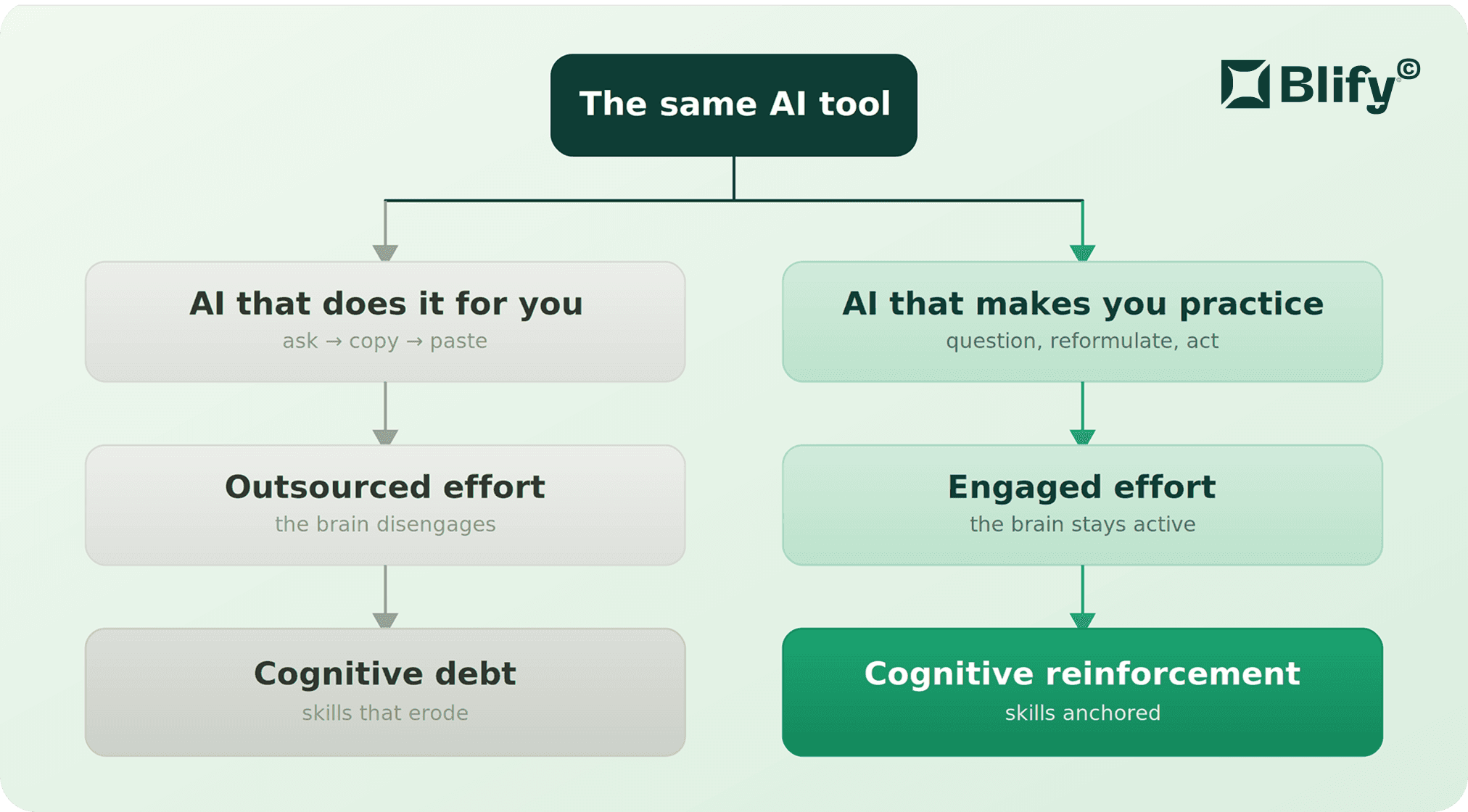
Same tool. Opposite trajectories. It all comes down to how you use it.
That is exactly the difference between a productivity assistant and a pedagogical agent. And it is on this boundary that L&D has a strategic role to play in the company's AI strategy.
"Generative AI carries the resolution of a paradox the training function has been wrestling with for many years: how do you deliver personalized training resources while distributing them at industrial scale?"
Florent Grisaud Verrier
Head of L&D, Deloitte, Blify × Deloitte × LearningFutures webinar, March 2026
Grisaud Verrier touches on an essential point here. The historical problem of L&D is that personalization and scale were incompatible. Conversational AI solves that equation, provided it is designed to make people learn, and not to answer.
What Blify does differently
Blify was designed from the start around this dividing line. It is not an AI that writes the presentations in place of the employee. It is a system of specialized AI agents that turns Slack, Teams, and WhatsApp into an active learning environment, at the moment the employee needs to practice, not to read.
In practice, this translates into several mechanics that directly engage the cognitive functions Kosmyna watched disengage in her EEGs.
AI role plays. A manager has to announce a difficult decision to their team? Blify sets up a conversational role play where the employee acts out the scene with an AI agent that embodies a realistic team member, with their objections, their emotions, their pockets of resistance. The manager has to articulate, adjust, defend. They do not read a tip sheet on feedback, they do feedback. This is exactly the Lira et al. condition: controlled practice, scaffolding, high quality examples.
Coaching in the flow of work. Rather than pushing a generic module at an arbitrary moment, Blify activates training at the instant the situation arises, a tense Slack message, an evaluation meeting to prepare, a client account to take over. The learner does not offload the decision: they make it, but with support. This is cognitive vigilance in the sense of Wang & Zhang.
Structured feedback and reformulation. Where ChatGPT gives an answer, Blify sends back a question, offers several angles, and forces the learner to reformulate their intention before producing anything. The learner's talk time doubles, a result that academic research on LLMs trained on pedagogical data now confirms robustly.
The result: no cognitive debt, but an accumulation of skills practiced in real contexts. This is what sets a pedagogical agent apart from an assistant that does the work for you.
The shift in stance for L&D
The picture is now clear for training teams: they can no longer settle for training employees on AI. They must now design learning experiences that use AI to strengthen, not replace, human intelligence.
This is a new responsibility, at the crossroads of L&D, AI strategy, and people development. It plays out on three levels:
Choose learning tools that actively engage cognition, rather than bypass it. The boundary is not AI versus no AI. It is active learning versus passive consumption.
Train employees in the partnership stance with AI, as Wang & Zhang describe it. Critical vigilance is cultivated. It does not appear spontaneously.
Measure long term impact, not just immediate velocity. Short term AI productivity gains can mask an erosion of skills over 12 to 18 months. L&D is on the front line to detect it and reverse it.
This is what the Blify × Deloitte × LearningFutures webinar of March 2026 called the move from "training plan manager" to "ecosystem architect": the L&D leader who knows when AI should do the work, when it should work alongside, and when it should step back to let the human practice.
Conclusion: cognitive debt is not a fate, it is a design choice
Three studies in less than twelve months have laid the foundations of a new framework for thinking about AI and learning. Kosmyna measured the cost. Wang & Zhang showed the condition for getting out of it. Lira et al. proved that demanding learning design can turn AI into a lever for sustainable skill development.
L&D is not meant to slow down AI adoption in the company. It is meant to steer how it is used, so that today's productivity gains do not become tomorrow's cognitive debt.
An AI that does the work for you weakens. An AI that makes you practice strengthens.
The entire mission of modern L&D fits inside that shift of preposition.
FAQ
What is cognitive debt? Cognitive debt is the silent accumulation of a long term cost, erosion of critical thinking, atrophy of basic skills, loss of ownership, when an individual delegates structuring acts of thinking to an AI. The concept was formalized by Nataliya Kosmyna and her team at the MIT Media Lab in 2025.
Do all AIs create cognitive debt? No. Research by Wang & Zhang (2026) and Lira et al. (2025) shows that the effect depends on the design of the experience and the stance of the learner. An AI designed to make people practice, question, and reformulate can, on the contrary, strengthen skills over the long term.
What is L&D's role in the face of this risk? L&D must choose and deploy learning tools that actively engage cognition, train employees in the partnership stance with AI, and measure impact on skills at 12 to 18 months, not just immediate productivity.
How does Blify address this? Blify is built around active mechanics: AI role plays, coaching in the flow of work, structured feedback that forces reformulation. The goal is to make the employee practice, not to produce in their place, the exact difference between cognitive debt and cognitive reinforcement.
Author(s)

Editorial Team
Blify
Share article

" height="31.333333333333332px" id="XBONSBlNT" transform="translate(0.667 0.333)" width="31.333333333333332px"/></svg>)
" height="30.080003383522584px" id="Hs3f2Yy2q" transform="translate(0.96 0.96)" width="30.080003383522588px"/></svg>)
" height="30.192665327961763px" id="vklF3ZAL2" transform="translate(0.03 0.891)" width="31.354222628899585px"/></svg>)