

If you work in L&D, you know the scene. Your teams are producing more than ever thanks to AI: drafts in a flash, modules in minutes, quizzes by the dozen. And yet, at the company level, you have the nagging feeling that nothing has actually moved. Leadership gets impatient, asks for results, and concludes that the training investment is not paying off. A study out of MIT and Wharton just put a number on this contradiction, across more than 100,000 developers, and its lesson holds for code as much as for your training programs. The real culprit was never the speed of production. It is where you put the AI. Spoiler: the very same tool can make your teams dependent, or make them better. It all comes down to where you place it.

©Blify
The productivity paradox, the MIT-Wharton study applied to L&D
The MIT-Wharton researchers tracked developers as they adopted increasingly powerful AI tools, from simple autocomplete to autonomous agents. The production gain is spectacular: with the most advanced agents, coding activity jumps by roughly 180 percent.
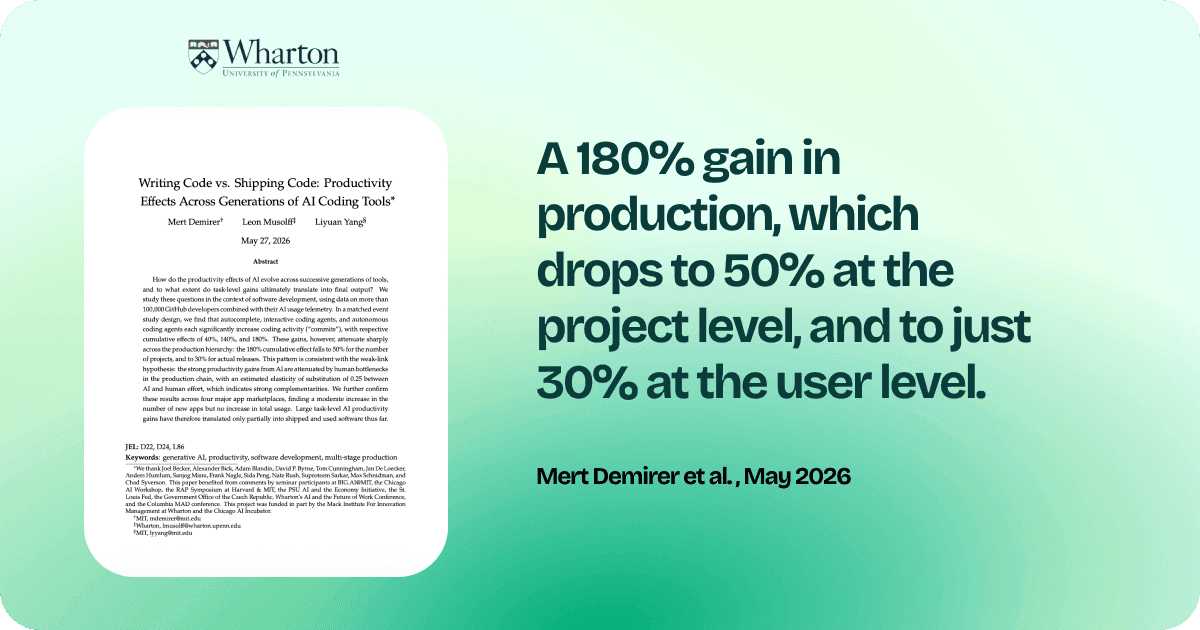
But here is the detail the sales pitches leave out. That gain erodes at every stage. The 180 percent at the production level drops to 50 percent at the project level, then to a mere 30 percent in versions actually shipped to users. Writing far more changed almost nothing about what truly reaches the end of the chain.
Now transpose that scene to your day to day. In a single afternoon you generate a complete onboarding path: ten modules, quizzes, a welcome handbook. Three months later, the new hire has opened two of them, and applied exactly one. You produced ten times more, but your impact did not budge.
Why the gain evaporates: the weak-link hypothesis
The reason is this: producing was never the bottleneck. Expert review, manager sign-off, integration on the ground, all of these steps rest on humans whose capacity has not increased. This is the weak-link hypothesis: speed up a step that is not the constraint, and total throughput does not move.
In reality, the cognitive load has simply switched sides. People no longer spend their time creating, they spend it adjudicating. And the mind tires faster validating than producing: checking content generated in seconds demands constant attention to catch the subtle error or the quiet contradiction. The gap every L&D leader knows is exactly here. It separates quantitative vanity, "we produced 100 modules instead of 10," from real impact, "behavior on the ground actually changed."
Generic AI saturates the human weak link without increasing learning transfer. To break through that ceiling, the role has to pivot: from content-catalog manager to skills-ecosystem architect. That shift in posture, and how to manage this technological paradox, is exactly what we explore in our webinar dedicated to the L&D function.






Webinar
A hands-on webinar to uncover mistakes, course-correct, and rebuild your L&D programs with impact

The same tool can make you dependent, or make you better
None of this is fixed, though. A study published in PNAS, run with nearly 1,000 high-school students, illustrates it perfectly. Students given a raw AI assistant, the kind that hands over the answer, saw their performance surge by 48 percent during the assisted exercise. But once the tool was taken away, they fell 17 percent below the group that had never used AI at all. The tool had become a crutch.
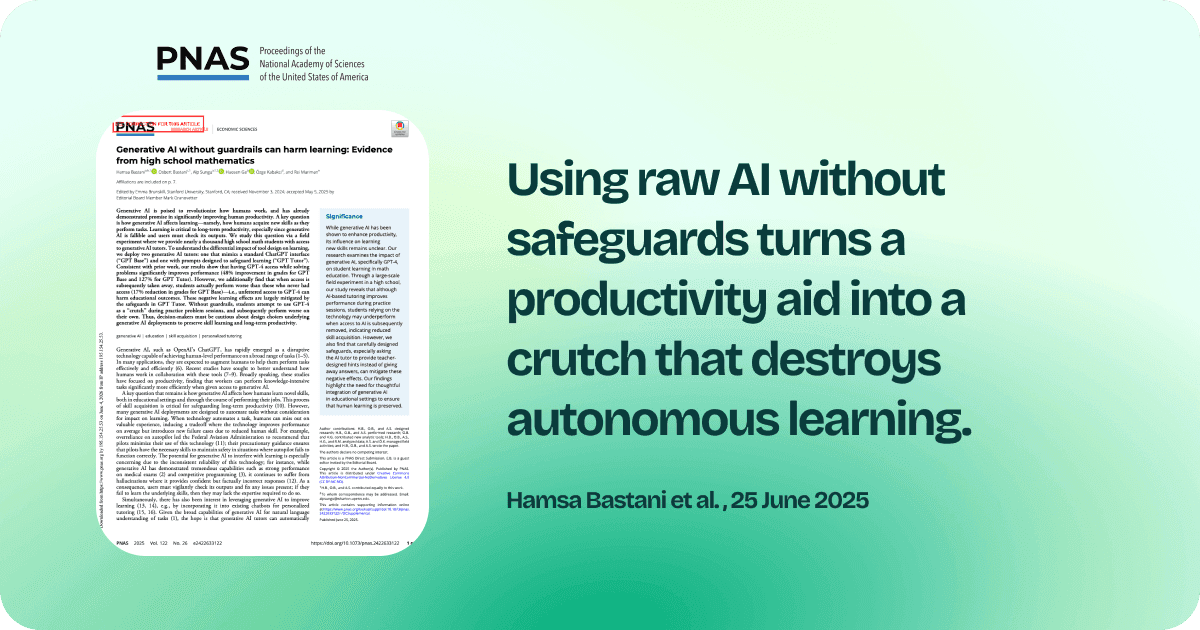
The same engine, this time designed as a tutor that asks questions and offers hints instead of delivering the solution, changed everything. Students gained 127 percent during practice, and crucially, the damaging effect vanished: their learning was preserved. The conclusion is clean. "Better" and "worse" did not come from two different technologies, but from the same tool placed in two different spots.
The lesson for you is direct. An assistant that writes the call report for your sales rep makes them faster today, and more dependent tomorrow. An agent that makes them rework their pitch and challenges them makes them better, durably. Same AI, opposite intent.
The real answer: move AI to the top of the chain
Concretely, what does "putting AI in the right place" look like inside your organization? It looks like 3 shifts, each worth more than 10 extra modules. This is the heart of an in the flow of work approach, where learning fires at the moment of real work.
Diagnose before you produce. Before ordering yet another training program, AI helps you settle the real question: is this a skills problem, a process problem, or a management problem? If your new sales reps are dropping off, the cause may be a badly sequenced onboarding, not a lack of content. One more module would change nothing.
Support inside the work. Feedback at the moment it matters, not three weeks later in a classroom. A debrief right after a botched client call, a reminder of the right reflexes slipped in before an annual review, delivered exactly where the manager already works, in Slack or Teams.
Anchor after the event. Training does not die at the end of the module. Nudge an employee three days later, have them replay an objection in a role-play right before their next real meeting, turn a theoretical takeaway into a lasting reflex.
That is the whole bet of an agent-based approach, in the flow of work, rather than a module generator bolted onto an old LMS where you still have to log in, find your place mid-path, and above all interrupt the work in front of you. When a sales rep rehearses before a real meeting, or a manager prepares a difficult conversation without leaving their inbox, AI is not adding content. It is acting where the value is won.
Conclusion
The productivity paradox is not an inevitable feature of AI. It is a placement error. As long as you put AI in the middle of the chain, to produce ever more, the gain evaporates on the human weak link and your teams learn to lean on a crutch. Move it upstream, to diagnose, support, and anchor in the flow of work, and the same tool starts reinforcing skills instead of eroding them.
Author(s)

Editorial Team
Blify
Share article

" height="31.333333333333332px" id="XBONSBlNT" transform="translate(0.667 0.333)" width="31.333333333333332px"/></svg>)
" height="30.080003383522584px" id="Hs3f2Yy2q" transform="translate(0.96 0.96)" width="30.080003383522588px"/></svg>)
" height="30.192665327961763px" id="vklF3ZAL2" transform="translate(0.03 0.891)" width="31.354222628899585px"/></svg>)