

“In the flow of work.” You’ve heard it in meetings, read it in an RFP, seen it on a vendor’s slide. It has become the password of modern L&D, and we stick it on everything: a trimmed-down e-learning module, an automated notification, a help bubble inside a piece of software. But dropping content into the tool where people work is not training them in the flow of work. Everyone loves the idea. Almost no one has truly pulled it off. What if the reason isn’t a lack of will, but a piece of technology that has only just arrived? Here’s the story.

©Blify
Learning at work isn’t a 2018 invention
The idea that work is a place to learn isn’t ten years old. It’s more than a century old. It was born with 19th-century industrialization. Until then, education was meant to shape the mind, far from any productive aim. The factory needed skilled workers, and fast, so it reconnected learning to the task, to the workstation, next to the person who already knew the job. A century later, an entire research field, Workplace Learning, took this as its subject: how do people actually learn while working?
That field established two things. The work situation is an exceptional place to learn, but the learning doesn’t happen on its own. It requires opportunities to learn, the right resources at the right moment, quality interactions. Without them, work teaches no one.
AFEST: France writes the intuition into law
In 2018, France took the leap. With the “Avenir professionnel” (Professional Future) Act of September 5, 2018, AFEST, the country’s officially recognized form of work-based training, became a training modality in its own right, on par with a classroom course. Learning while working was no longer a tolerated workaround. It was training you could fund and had to prove.
But AFEST also shows, in the negative, why the flow of work stayed so rare. To train for real, it assembles the conditions research had identified, one by one: a work situation chosen on purpose, a tutor observing the task, a debrief that puts words to what just happened. Exactly what works, and exactly what doesn’t scale. One tutor per learner, hours of coaching per skill: artisanal and time-consuming by nature. Wonderful for one employee. Untenable for ten thousand.
2018: Bersin puts a modern name on an old idea
The same year, on the other side of the world, analyst Josh Bersin theorized the idea and named it: learning in the flow of work. His thesis is simple. For 40 years, training followed technology, the classroom, then e-learning and the LMS, then Netflix-style video libraries. At every step, employees were asked to leave their work to go learn somewhere else.

Bersin flips the logic. Training shouldn’t pull us away from work; it should come to us, at the precise moment of need. His founding observation still holds. According to the LinkedIn Workplace Learning Report 2018 he cites, the number-one barrier to training isn’t budget or motivation, it’s time: the average employee has just 24 minutes a week to learn. No wonder nearly one in two asked to learn directly in the flow of their work.
L&D’s best idea, the one no one could deliver
Here’s the paradox. Everyone buys in. Almost no one succeeds. In 2022, The Josh Bersin Company surveyed more than 1,000 organizations: 78% ranked training among their leadership priorities, yet only 12% truly cracked learning in the flow of work. A cult idea, a laughable hit rate.
Why the gap? Because what we called “flow of work” for years wasn’t. It was micro-content pushed without context, ignored notifications, scripted help bubbles. We were delivering content, never training. None of the conditions research had identified were met, not the right moment, not the right resource, not the quality interaction. What was missing was an intelligence that could understand who the employee is, what they’re doing right now, and respond like a trainer would. The promise was ahead of its technology.





Webinar
With 2 billion weekly interactions on ChatGPT, "Shadow AI" is your new L&D reality. Your teams aren't waiting for the LMS. Discover how to stop fighting informal usage and start orchestrating it into a scalable, data-driven performance strategy.

The missing link is called AI
What was missing, generative AI now supplies. For the first time, a system can read the work context, hold a natural-language conversation, adapt to each person, and step in at the right moment, instead of passively waiting for someone to log in to a platform. The conditions research called essential are finally within reach at scale.
We move from static content to a counterpart you can talk to. No longer a video you watch, but a trainer who asks a question, corrects an answer, rephrases to your level. This is exactly the break The Josh Bersin Company flags in 2026: in a training market that has grown from $200 to $400 billion, thirty-year-old e-learning courses no longer cut it, and fewer than 5% of companies have deployed a truly AI-native approach. The field is wide open, and it has only just opened.
The new equation: right place, right moment, right content
Real learning in the flow of work now comes down to three conditions, the modern translation of what research had been asking for all along. You need all three.
Right place, first: where the work actually happens, in Slack, Microsoft Teams, WhatsApp, even the rep’s CRM. Not on a separate platform that demands one more login and gets forgotten.
Right moment, next: at the precise point of need, before a tough client meeting, the day a new procedure ships, during a new hire’s onboarding. Not three weeks later, once the value has evaporated.
Right content, finally: personalized, fed by the company’s real context, tailored to each person’s role and level. Not a generic module served identically to ten thousand very different people.
Learning for impact, not to check a box
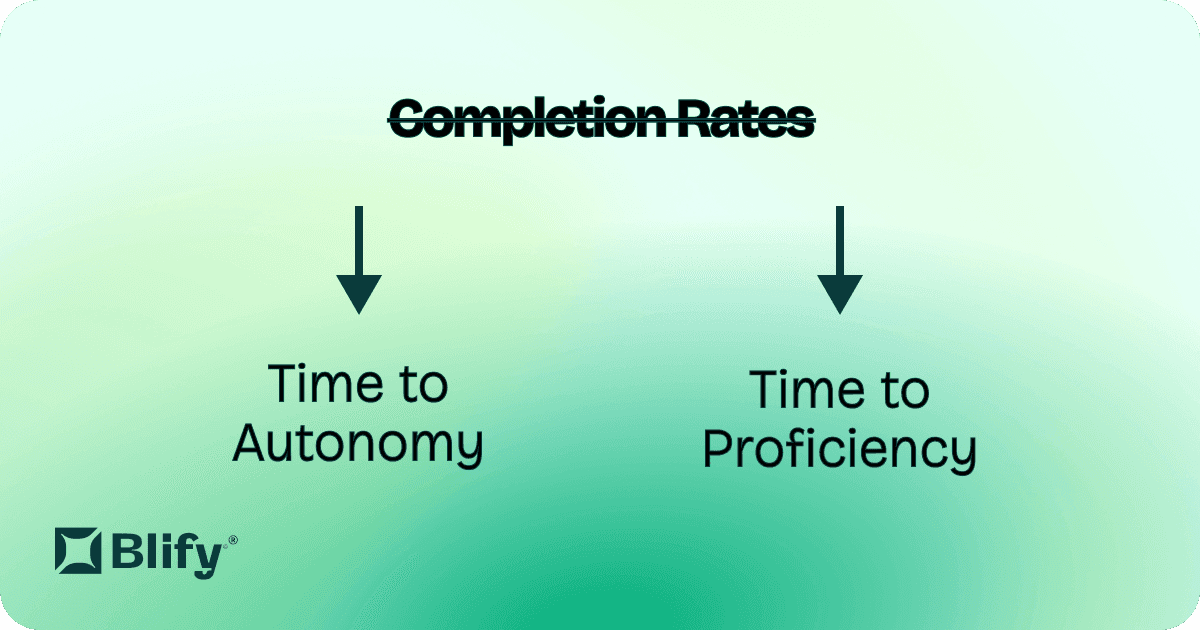
This shift plugs training back into performance. In 2026, Josh Bersin renamed his own concept: no longer learning in the flow of work, but dynamic enablement. We don’t learn to learn anymore, we learn to perform. The metrics follow: out goes the completion rate, in come a new hire’s time to autonomy and a sales team’s time to proficiency.
For L&D, the role shifts just as much: you no longer push a catalog, you design and orchestrate agents. And the use cases that resisted classic training the most finally turn continuous: onboarding with an always-on companion in the chat, sales enablement that feeds the right answer to an objection at the right second, compliance replayed continuously instead of once a year, AI adoption trained in the flow, where the work is actually changing.
Conclusion
Learning in the flow of work wasn’t waiting for a better idea. It was waiting for its technology. The value of learning on the job had been established for a long time, from work-based pedagogies to the Workplace Learning research, and AFEST had even written it into French law. Bersin had named the vision. What was missing was the engine: the one that could finally assemble the right conditions, at the right moment, for each person. AI just delivered that engine. And it moves training toward the only thing that matters, impact.
Author(s)

Editorial Team
Blify
Share article

" height="31.333333333333332px" id="XBONSBlNT" transform="translate(0.667 0.333)" width="31.333333333333332px"/></svg>)
" height="30.080003383522584px" id="Hs3f2Yy2q" transform="translate(0.96 0.96)" width="30.080003383522588px"/></svg>)
" height="30.192665327961763px" id="vklF3ZAL2" transform="translate(0.03 0.891)" width="31.354222628899585px"/></svg>)