

For the past year, every HR vendor has been announcing its AI agents. LMSs have theirs, LCMSs too, and LXPs keep raising the stakes. From a distance, it looks like a breakthrough. Up close, it's far more lukewarm. In almost every case, AI is used to do faster what was already being done: off-the-shelf content, mass-produced but just as static, or assistants that are yesterday's bots with a fresh coat of paint, disconnected from real work and from the organization's knowledge. The label changed. The substance didn't. And that's exactly where everything plays out: what does an agent actually change if it isn't where the work happens?

@Blify
What a platform of agents is (and why now)
Josh Bersin coined the term in two steps: from static training to dynamic enablement, then from system of record to platform of agents. The LXP already promised to move beyond the LMS; mostly, it put a nicer interface on the same editorial model: produce content, publish it, hope for usage. A platform of agents swaps out the engine. Dedicated agents analyze context, create content, detect learning moments, then actively train people, through conversation, in the flow of work.
Where does that learning live? In the agentic stack Bersin describes in 4 layers (systems of record, cross-functional applications, agents, superagents), the LMS is just one application in layer 2. The agent operates in layers 3 and 4, but draws all its value from layers 1 and 2, where the company's data and context reside.
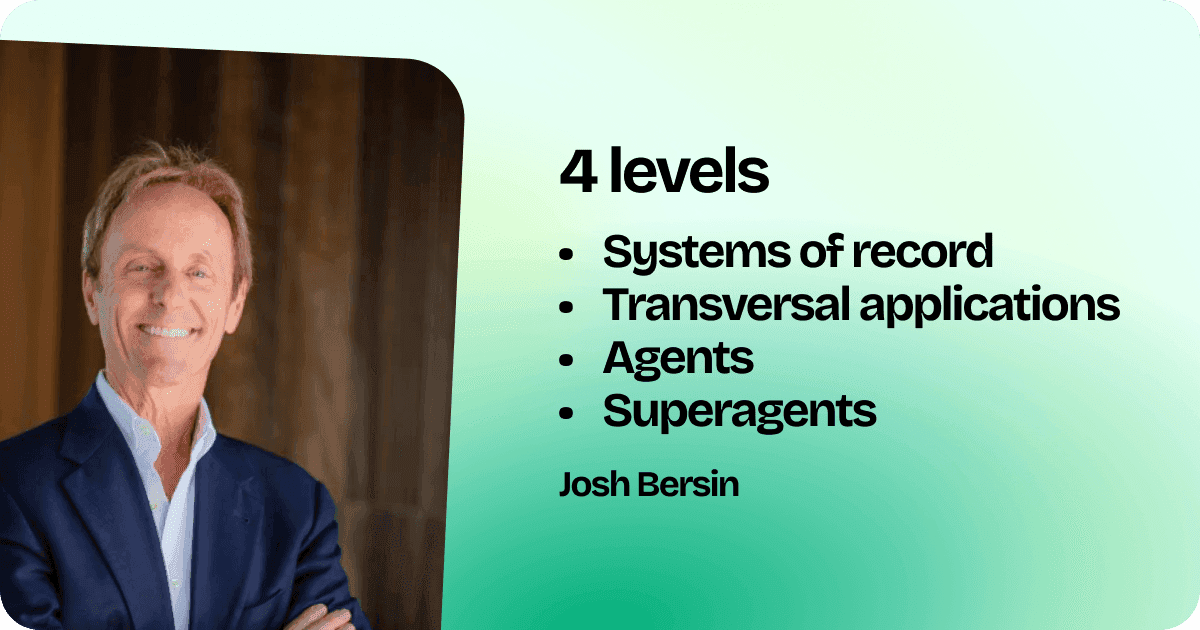
And why now? Because the two locks that made the promise of personalized learning fail for a decade have just come off: models can finally hold a conversation and assess continuously, and the cost of 1:1 has collapsed. An agent is not a chatbot bolted onto the LMS. It's the base unit of a new infrastructure.
No proprietary data, no agentic learning
An agent is only worth what it knows about you and your organization. A platform of agents only delivers on its promise (being genuinely plugged into the work and the day-to-day reality of your teams) if its agents draw on the company's own context. Without that raw material, even the most sophisticated agent remains a generalist with no ground truth: it recites instead of fitting the actual situation.
That context comes in 2 forms. On one side, hot, structured data, the kind that lives in systems of record: CRM, meeting recordings, HRIS. On the other, warm or cold, less structured data: internal documentation, shared drives, scattered procedures. The first tells you what's happening now; the second carries the organization's memory and rules. A useful, high-performing agent needs both.
Then comes the obstacle nobody names: identifying those sources and understanding their agentic relevance. Where to look? What's relevant, what's just noise? For many HR and L&D leaders, this is uncharted territory, scattered across dozens of tools. That's where the Blify team steps in, upstream of deploying its agentic learning platform: mapping the useful sources with you (SharePoint, Drive, HRIS, CRM…), connecting agents to them through native connectors, and turning your existing resources (PDFs, in-person sessions, virtual classrooms) into training programs without starting from a blank page.




Webinar
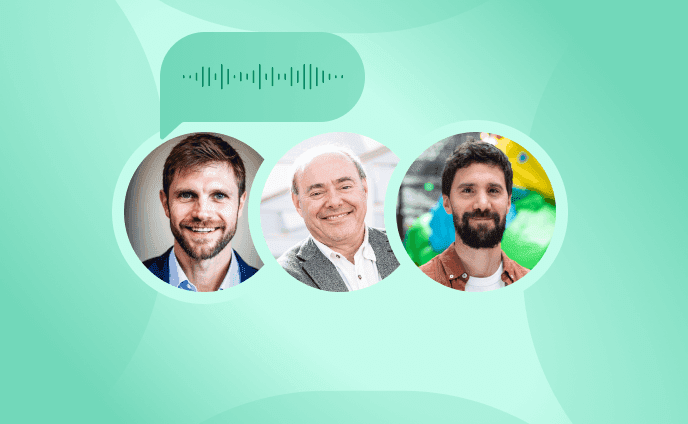
Building on the visionary work of Peter Senge, Florent Grisaud Verrier (Head of L&D, Deloitte), Thierry Bonetto (Founder, LearningFutures), and Clément Lhommeau (Co-founder, Blify) will detail how to balance technological amplification with human vigilance. They will share concrete tools to embed learning directly into the flow of work. This is an essential roadmap to shift away from administrative management and finally orchestrate dynamic skills ecosystems.
What this changes for corporate learning
The job shifts from catalog manager to skills-ecosystem architect. Less time producing and administering modules, more time designing the ecosystem: which populations, which moments, which sources of context, which guardrails. It's a shift in the center of gravity, not a disappearance: orchestrating rather than stacking.
Measurement follows the same movement. The completion rate measured catalog consumption; it loses its object when learning lives in conversation. What you track now is behavior and performance, broken down into short, named use cases: an onboarding that shortens time to autonomy, a sales enablement program that trains on this month's real objections, a compliance program that proves acquisition instead of proving the click. That's exactly the scale at which a Blify agent deploys: 1 agent configured on a concrete plan, one population, one observable outcome.
The trap: agentifying the old world
Let's be honest: not everything is worth agentifying. Dropping an agent onto an existing workflow, generating the same modules faster, answering the same tickets, brings modest gains. In corporate learning, the real return comes from an agent that owns an entire chain, what analyst Josh Bersin calls a stage 3 agent: diagnose a need, build the response, drive practice, measure, follow up.

The second trap is pedagogical. An agent that answers in place of the employee creates dependency. That's the mechanism of cognitive debt: performance climbs as long as the tool is there, while the underlying skill atrophies. An agent that questions, drives practice, and corrects makes people better. Same AI, opposite intent. One last marker of the same trap: an agent that lives on a third-party platform you have to visit reproduces the very portal it claimed to replace. The agent lives where the employee already works.
How to recognize a real platform of agents (and not a repainted chatbot)
Now for the most useful part: how do you judge when you have to make a buying decision? 4 criteria separate a natively agentic platform from an LMS with a chatbot bolted on.
Agents that act, not just answer. They carry tasks end to end (diagnose, build, follow up, measure) and they're proactive: they detect the right moment and push personalized content on their own, instead of waiting for a question.
In the flow of work, not another portal. Accessible where the work happens: business messaging tools like Teams or Slack, and line-of-business tools (CRM, ticketing, logistics, booking…). Not yet another destination to visit.
A loop that closes. Impact measurement feeds back into the system: what the agent observes in the field informs the next diagnosis. Without that return arc, you have a content generator, not a platform of agents.
Humans keep control and accountability. Diagnosis validated by a subject matter expert, an explicit go/no-go decision, a system of agents connected step by step rather than one isolated, opaque agent. Accountability is never delegated.
A vendor that checks all four has changed its model. A vendor that checks only one has changed its slogan.
Conclusion
The debate is no longer LMS vs. LXP: both belong to the same world, that of the catalog you publish while hoping for usage. The real dividing line now runs between catalog and agents, between content that waits and infrastructure that acts. So, if you ran your current tools through the 4 criteria, how many would check even one? It's often the fastest question to figure out where you stand. And if you want to see what an agent connected to your organization's knowledge looks like in real conditions, Blify embodies this platform-of-agents movement for corporate learning.
Author(s)

Editorial Team
Blify
Share article


" height="31.333333333333332px" id="XBONSBlNT" transform="translate(0.667 0.333)" width="31.333333333333332px"/></svg>)
" height="30.080003383522584px" id="Hs3f2Yy2q" transform="translate(0.96 0.96)" width="30.080003383522588px"/></svg>)
" height="30.192665327961763px" id="vklF3ZAL2" transform="translate(0.03 0.891)" width="31.354222628899585px"/></svg>)