

Shadow AI and Corporate Training: Why your 2026 learning strategy is already behind
7
min
Your employees didn't wait for sign-off before adopting AI. According to the 2025 Ifop/Talan Barometer, 45% of French workers already use generative AI, yet only 15% have been trained and just 9% have a company-provided tool. The 2026 CRÉDOC Digital Barometer confirms the scale: nearly one in two employees now reports using generative AI. In 25 years of tracking, no technology has ever moved this fast. Most are figuring it out on their own, and many are using AI not just to produce, but to learn. Meanwhile, 2026 L&D roadmaps still run on the same three-legged stool as 15 years ago: eLearning, in-person, virtual classroom. If your workforce has already changed how it learns, why is L&D still looking the other way?

®Blify
Shadow AI: A Misleading Label
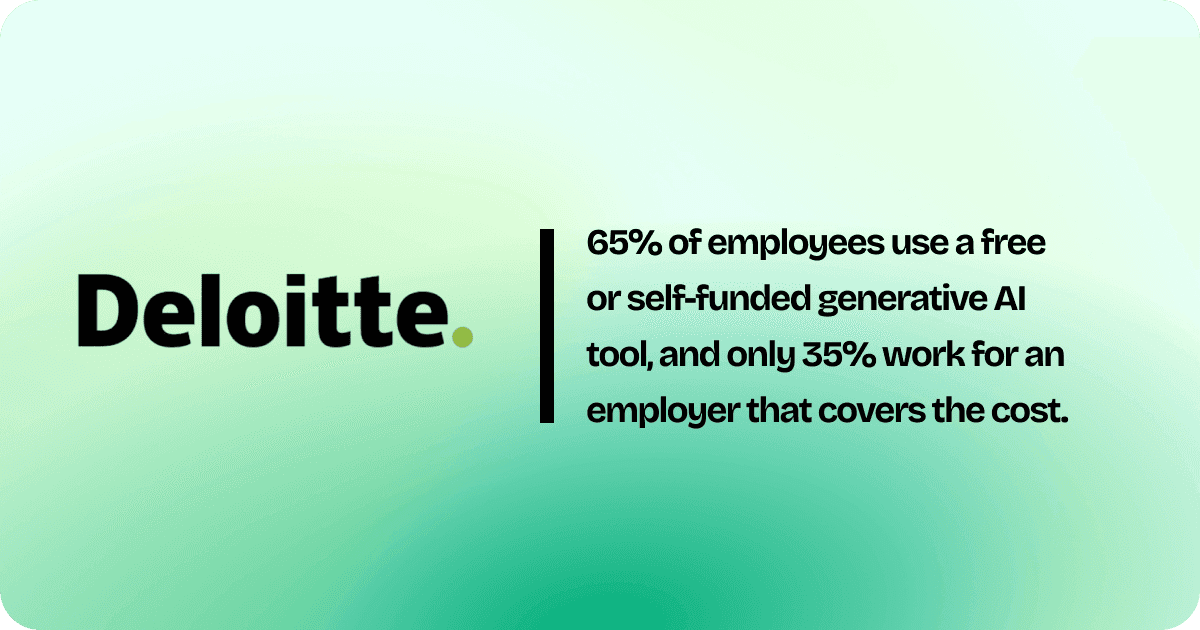
"Shadow AI" refers to the use of AI tools that haven't been provisioned or vetted by the company. The phenomenon is massive. According to Deloitte's third GenAI Barometer, 65% of employees use a free or personally funded generative AI tool, and only 35% work for an employer that covers the cost. In the U.S., Deloitte estimates that nearly 7 in 10 employee AI users rely on their own tools while at work. Shadow AI isn't a niche trend, it's the default mode of AI adoption.
The typical response is well-worn: tighten what goes out. Data leakage, compliance exposure, a confidential contract snippet landing in a third-party AI system, these are legitimate concerns. But they focus the spotlight on only half the problem. While organizations are watching what escapes, no one is watching the value that never comes in: the thousands of daily prompts that reveal your workforce's real, in-the-moment skill gaps, and that vanish without being captured.
"Shadow AI is the use of AI tools and solutions within a company by employees, without prior approval from the organization."
Paul-Augustin Dennery, Managing Director at Learn Assembly, (Webinar: "Your employees are already learning with AI, how do you take back control?")
Your Employees Aren't Cheating, They're Learning
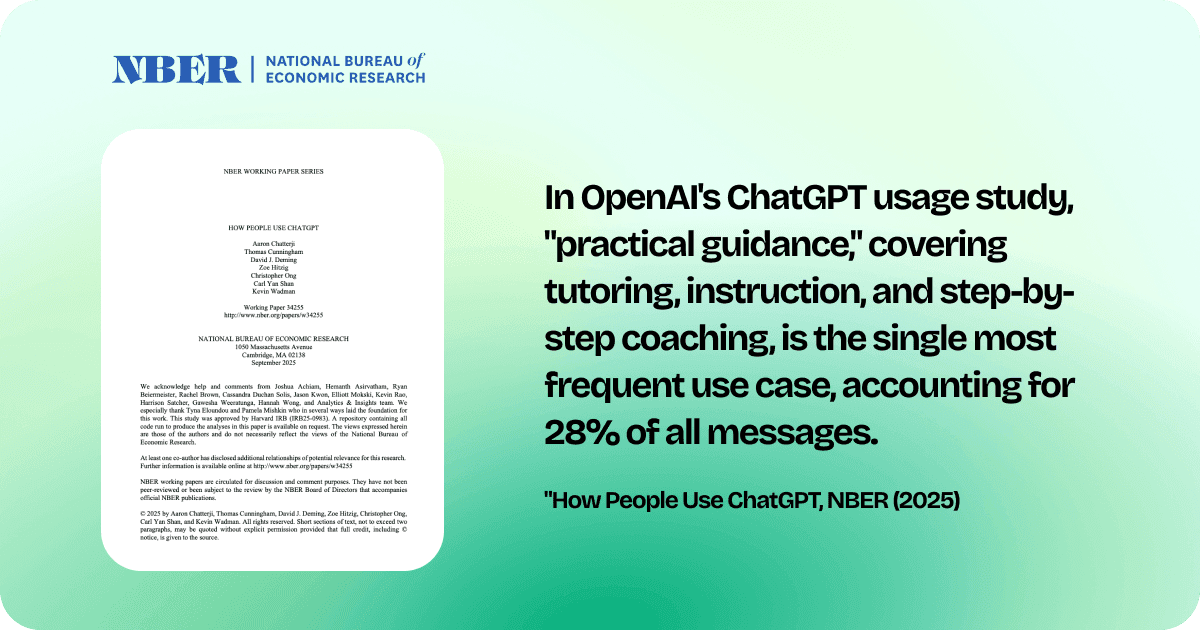
The usage data makes this clear. In OpenAI's landmark study on ChatGPT usage (NBER, 2025), the "practical guidance" category, encompassing tutoring, instruction, and step-by-step coaching, was the single most frequent use case, accounting for 28% of all messages. One could argue that ChatGPT's user base skews broad, with students driving the numbers up. A Microsoft Copilot study puts that objection to rest: across 200,000 conversations analyzed in near-exclusively professional environments, the finding is identical. Learning ranks among the most frequent user objectives, while teaching and advising rank among the most frequent AI behaviors, with the AI acting as coach, tutor, or trainer.
When a sales rep asks an AI to walk them through a contract clause, when a manager rehearses a difficult conversation before having it, they aren't circumventing policy. They're upskilling. Every prompt is a real skill gap, expressed at the exact moment of need, in the employee's own words. This is the lens Blify brings to the issue, and it's what makes the situation so paradoxical: in the shadows, the most valuable signal in L&D is being thrown away. Not a self-reported indicator collected six months late through an annual survey, but a live map of what your workforce hasn't yet mastered.






Webinar
With 2 billion weekly interactions on ChatGPT, "Shadow AI" is your new L&D reality. Your teams aren't waiting for the LMS. Discover how to stop fighting informal usage and start orchestrating it into a scalable, data-driven performance strategy.

What Blind L&D Costs HR
The result is a widening gap between what training programs schedule and what employees actually need. Josh Bersin puts a number on it: 74% of organizations say they can't keep pace with the demand for skills, across a corporate learning market worth more than $400 billion globally. Companies are pouring resources into catalog management while the real learning need surfaces elsewhere, quietly, in a chat window. The problem isn't the budget, it's the model, and that's the core challenge of shifting L&D from training plan management to learning ecosystem architecture.
Why does this signal disappear instead of surfacing? The reasons are rational, not malicious. Fear of admitting a knowledge gap and being seen as replaceable. Reluctance to ask a question that feels too basic in front of a colleague or direct manager. The friction of a heavy internal tool, when an external AI responds in three seconds. And the straightforward reality that only 9% of employees have a company-issued AI tool to begin with. When the organization doesn't provide an alternative, the need doesn't disappear, it migrates out of view.
On the fear of disclosing AI use: "The more I use it, the more I encourage the organization to go AI-first, and the more I risk making myself redundant. I don't know anyone who saws off the branch they're sitting on. If I stay under the radar, I boost my productivity, but I don't share those numbers with the company."
(Webinar: "Your employees are already learning with AI, how do you take back control?")
Capturing the Signal Without Surveilling Anyone
There is, however, a viable middle path. Capturing this signal doesn't mean monitoring every query. It means working with anonymized, aggregated data, and targeting collective intent rather than individual behavior. What matters isn't "who asked what," but "which skill need comes up often enough to warrant a team-level response." Shadow AI then becomes a virtuous cycle: one employee's individual discovery becomes a micro-learning moment that benefits the whole team.
"We can go further: capturing intent through anonymized platforms is a key lever for identifying the questions employees are asking day to day, analyzing skill needs by team. This data can be collected, integrated into the training plan and reporting, and shared with employee representative bodies."
Clément Lhommeau, Co-founder of Blify (Webinar: "Your employees are already learning with AI, how do you take back control?")
To keep this signal inside the organization, the deeper fix is to stop sending employees to learn elsewhere in the first place. That means embedding learning in the flow of work, where the question arises, inside Slack, Teams, or the tools employees already use, rather than a catalog they have to log into separately. The model shifts from inventory to flow, from declared intent to actual behavior. This is precisely the transition described by the move from LMS to Learning Operating System. A platform like Blify deploys AI learning agents directly inside everyday work tools: the need is met in place, and the signal it generates stays within the organization instead of evaporating into a third-party AI provider.
Conclusion
Shadow AI isn't a leak to plug. It's a compass that most organizations choose to ignore, out of a control reflex, at the exact moment it's most reliably pointing the way forward. Every question sent to an external AI is a skill need made explicit: timestamped, contextualized, phrased in the employee's own language, and free. Captured and aggregated, this stream tells you in real time what no annual survey will ever surface: where your teams are stuck, on what, and when. Left unaddressed, it continues fueling a body of knowledge that builds outside the organization instead of circulating within it, widening the gap between what training programs schedule and what the work actually requires. The divide taking shape in 2026 doesn't separate companies that allow AI from those that ban it. It separates those that keep guessing what their workforce needs from those that have finally decided to listen.
Author(s)

Editorial Team
Blify
Share article



" height="31.333333333333332px" id="XBONSBlNT" transform="translate(0.667 0.333)" width="31.333333333333332px"/></svg>)
" height="30.080003383522584px" id="Hs3f2Yy2q" transform="translate(0.96 0.96)" width="30.080003383522588px"/></svg>)
" height="30.192665327961763px" id="vklF3ZAL2" transform="translate(0.03 0.891)" width="31.354222628899585px"/></svg>)