

Every technology wave brings the same promise back: personalized learning journeys, for everyone. The first LXPs swore they would deliver tailor-made learning. What we got was recommendation engines. Twelve years later, conversational AI reopens the file, and the whole industry wants to believe again. Before we re-sign the same promise, let's ask the real question: why did it hold for so long without ever scaling, and what, this time, is different in kind? Spoiler: it isn't that the models recommend slightly better.

@Blify
The old L&D dream: a tutor for everyone
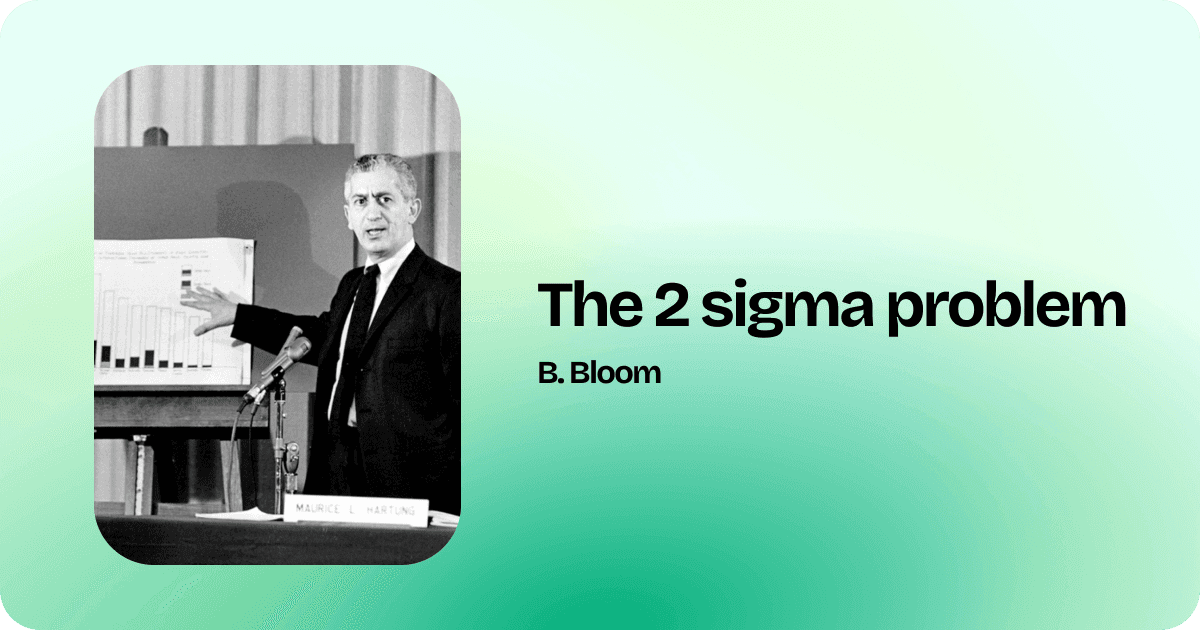
In 1984, the psychologist Benjamin Bloom measured something unsettling. Students taught one-on-one, using mastery learning, outperformed on average 98% of students in a conventional classroom. This is the famous 2 sigma problem. Let's be honest: the exact effect has never been replicated as stated, and researchers still debate it. The direction, though, is not in doubt. The 1:1 setting remains the best condition for learning we know how to create.
Bloom himself names the catch: a tutor per head costs too much to hold at scale. For 40 years, the entire history of L&D comes down to a single quest, making that 1:1 affordable.
Two promises, not one, and two failures
To get there, 2 currents coexisted. On one side, LXPs, born around 2012, the first of their kind. They promised a tailor-made journey for everyone; what they mostly delivered was a recommendation engine grafted onto a user profile. But recommending is not adapting. On the other side, a far more ambitious vision, quickly forgotten: adaptive learning. As early as 2008, the American company Knewton wanted to map each learner's strengths and weaknesses to inject the right content, with no human intervention. Smart Sparrow in Australia (2011), then Domoscio in France (2013), chased the same obsession: not to suggest anymore, but to adjust in real time.
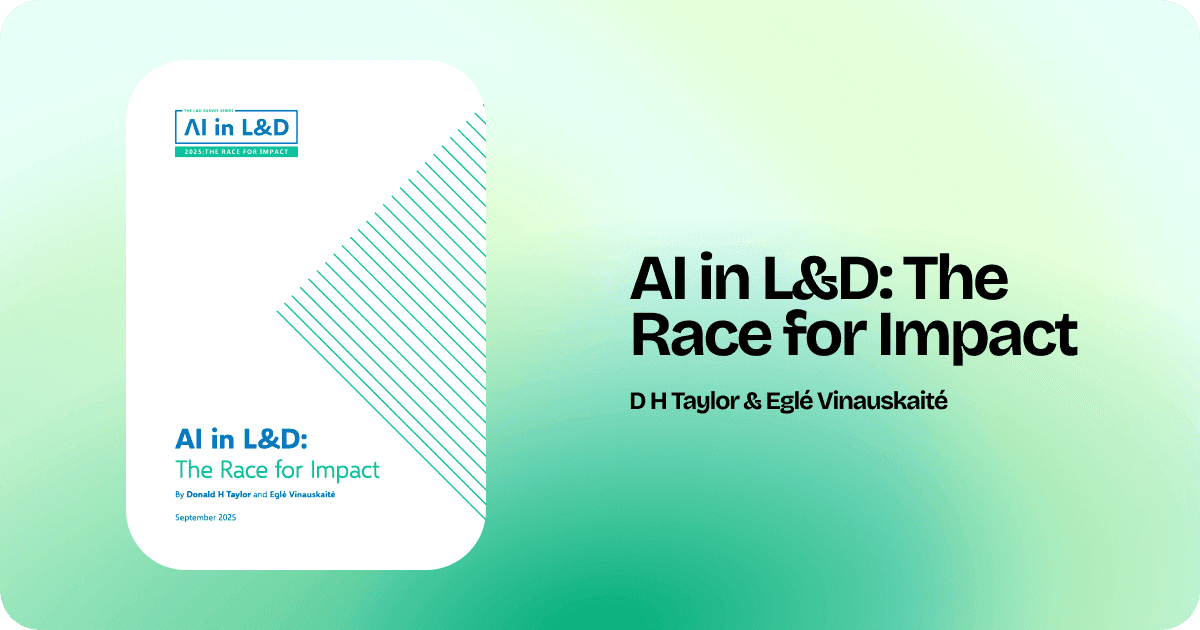
None of them scaled. Knewton, after promising a great deal, ended up acquired by Wiley in 2019, far below the amounts it had raised. Its peers were absorbed by other players. The instinct of instructional design, meanwhile, never moved a notch. The work of Donald H. Taylor and Egle Vinauskaitė shows it: AI in L&D today still serves as a content super-factory, far more than as a tool for personalization. The technology changed twice. Our habits, never.
The real diagnosis: 2 locks, not one
These failures are often summed up in one phrase: too expensive, too soon. That's incomplete. There were 2 locks. The first, technical: the AI of the 2010s was simply too limited. Weak models, insufficient compute, and above all the cold-start problem that demanded mountains of labeled data before producing a single relevant recommendation.
The second lock, deeper, follows from the first. Unable to truly hold a dialogue or assess continuously, these tools stayed trapped in a content-centric model: match a profile measured once to pre-existing content, a straight-line trip from A to B, with no correction loop. But no one learns in a straight line. A smart catalog is still a catalog. Right goal, wrong engine, and an engine throttled by its era.






Webinar
With 2 billion weekly interactions on ChatGPT, "Shadow AI" is your new L&D reality. Your teams aren't waiting for the LMS. Discover how to stop fighting informal usage and start orchestrating it into a scalable, data-driven performance strategy.
What conversational AI really changes
This time, the models crossed a threshold. But the real shift isn't about better recommendations. It's about what the old AI couldn't do: hold a conversation. We move from a logic of recommendation to a new one of conversation. Assessment becomes continuous, inside the flow of the exchange, and the journey becomes a loop instead of a straight line. The staircase turns into an escalator.

The numbers are starting to follow. At Harvard, Gregory Kestin's team compared in 2024 a well-designed AI tutor against an active learning class, across nearly 200 physics students. The result: they learn more than twice as much, in less time, with the AI tutor. For the first time, both locks fall together. Bloom's 1:1 becomes addressable at scale. We leave 1-to-Many behind to aim for 1:1 for everyone.
The promise will hold only on 3 conditions
The signal first: no relevant personalization without living material to feed the loop. Learning must be plugged directly into the company's tools and knowledge bases, the systems of record, where up-to-date data flows. But plugging AI into them is not enough: that data must be structured and labeled, otherwise the adaptation rests on noise and falls back into recommendation in disguise.
Measurement next: continuous, inside the flow of the exchange, never deferred to an end-of-journey exam. And this measurement isn't just a dashboard, it is itself a primary source of signal: what you observe in real time feeds the loop again and tunes the journey as close to the work as possible. Still, you have to measure the right thing. Not surface engagement alone, the blind spot of the completion rate, but what the learner understands and can do again: where they get stuck, the questions they ask, their ability to apply a concept to a real case. That runs through dialogue and practice, not an exit quiz.
Reinforcement last: an AI that answers in your place is not a tutor, it's a crutch. It hands over the solution, spares you the effort, and leaves you just as helpless the next time. A good AI does the opposite: it makes you search, rephrase, practice, even if that means handing the question back rather than the answer. It builds muscle instead of assisting, that's the whole stakes of cognitive debt.
Conclusion
The promise of 1984 is finally within technical reach. It won't hold on its own. Everything comes down to one choice: resell the dream and deliver, yet again, a catalog in disguise, or build journeys that adapt for real, in a conversational logic, anchored in the flow of work, where the agent makes you work instead of thinking in your place. 1:1 for everyone is no longer a budget fantasy. It has become an architecture decision for your L&D strategy.
Author(s)

Editorial Team
Blify
Share article

" height="31.333333333333332px" id="XBONSBlNT" transform="translate(0.667 0.333)" width="31.333333333333332px"/></svg>)
" height="30.080003383522584px" id="Hs3f2Yy2q" transform="translate(0.96 0.96)" width="30.080003383522588px"/></svg>)
" height="30.192665327961763px" id="vklF3ZAL2" transform="translate(0.03 0.891)" width="31.354222628899585px"/></svg>)